
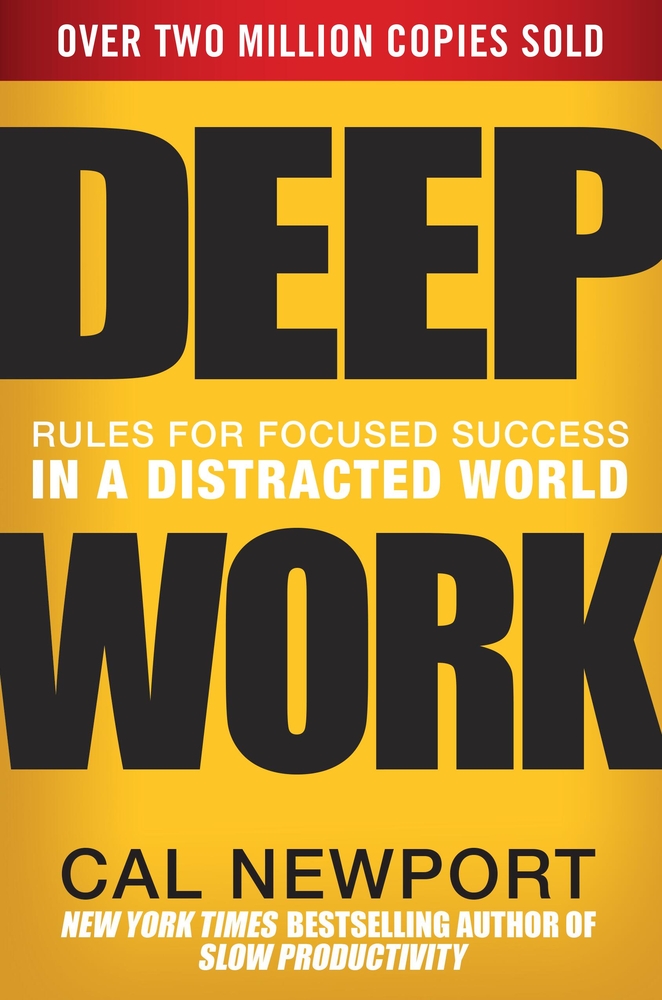
Deep Work by Cal Newport is a groundbreaking book that explains how focused, distraction-free work is the key to achieving extraordinary results in today’s increasingly distracted world. Newport argues that the ability to focus deeply on cognitively demanding tasks is rare, yet incredibly valuable. By cultivating deep work habits, professionals, students, and creatives can dramatically improve productivity, creativity, and personal satisfaction. This book provides both a theoretical framework and practical strategies for integrating deep work into daily life.
What Is Deep Work and Why It Matters
Newport defines deep work as professional activities performed in a state of distraction-free concentration that push your cognitive capabilities to their limit. This type of work creates new value, improves skills, and is hard to replicate. In contrast, shallow work—like emails, meetings, and social media scrolling—consumes time without generating meaningful results. Newport emphasizes that in an era of constant notifications, the ability to perform deep work is like a superpower. Those who master it can achieve more in less time, gain career advantages, and feel a greater sense of fulfillment.
In today’s economy, knowledge workers are measured not just by hours worked, but by the quality of output. Deep work allows you to produce high-quality results efficiently. It also fosters skill acquisition, as intense focus accelerates learning and expertise. Newport warns that constant shallow work can erode creativity, reduce attention span, and lead to burnout. Protecting blocks of time for deep work is not optional for high achievers—it is essential.
The Core Concept of Deep Work and Its Importance
The central premise of the book, known as the Deep Work Hypothesis, is simple yet powerful: the ability to perform deep work is increasingly rare at exactly the same time it is becoming increasingly valuable in the economy. Those who cultivate this skill will thrive, while those who remain trapped in shallow work risk stagnation. Newport provides examples from various professions, showing how deep work leads to breakthroughs in technology, business, and science.
The hypothesis also challenges cultural norms. Modern workplaces reward constant availability, email responsiveness, and multitasking—behaviors that encourage shallow work. Newport calls for a conscious rejection of these norms, advocating for deliberate focus and structured routines. By embracing the deep work philosophy, individuals can gain a competitive edge, maximize learning, and enjoy more meaningful work.
Rules for Cultivating Deep Work in Daily Life
Cal Newport outlines four key rules to cultivate deep work in daily life. Each rule provides a strategy to minimize distractions, maximize focus, and create a sustainable workflow that supports productivity and personal growth.
Rule 1: Work Deeply
The first rule emphasizes designing your environment and routines to protect deep work. Newport argues that achieving deep work is not just about willpower—it requires deliberate practice. He recommends techniques such as:
- Time blocking: Scheduling uninterrupted blocks of time dedicated exclusively to deep work.
- Ritualizing work: Creating a consistent routine, including location, start time, and tools, to make entering a focused state easier.
- Eliminating distractions: Turning off notifications, clearing your workspace, and setting boundaries with colleagues or family members.
By prioritizing deep work in your schedule, it becomes a habit rather than a rare effort. Newport highlights that small, consistent steps in protecting your focus are more effective than occasional bursts of concentration.
Rule 2: Embrace Boredom
Newport notes that the modern brain has been trained for constant stimulation, making it difficult to focus on demanding tasks for extended periods. Embracing boredom is about resisting the urge to switch to shallow activities whenever attention wanes. He suggests:
- Scheduling regular periods without distractions.
- Practicing concentration exercises, such as reading or working on challenging tasks without interruptions.
- Training your mind to tolerate discomfort and delay gratification.
This rule strengthens mental discipline and reinforces the ability to sustain deep work sessions, which ultimately leads to higher productivity and skill development.
Rule 3: Quit Social Media (or Use It Wisely)
Newport challenges readers to reconsider their relationship with social media. He argues that social media platforms are designed to capture attention, often at the expense of deep work. Key strategies include:
- Conducting a social media audit to evaluate whether each platform genuinely adds value.
- Eliminating tools that are distracting or unnecessary.
- Restricting use of essential platforms to specific, intentional windows of time.
By reducing shallow consumption of digital content, individuals free up mental bandwidth for high-value tasks that produce measurable outcomes.
Rule 4: Drain the Shallows
The fourth rule is about minimizing shallow work in your schedule. Shallow work is necessary at times, but it should be strictly managed. Newport provides guidance such as:
- Scheduling shallow tasks in designated blocks.
- Setting limits on emails and meetings.
- Automating or delegating repetitive tasks whenever possible.
By creating boundaries around shallow work, you preserve time and energy for the activities that matter most, ensuring that your focus is spent on creating value, not just staying busy.
Strategies for Integrating Deep Work Into Daily Life
Cal Newport emphasizes that deep work is not just a concept—it’s a practical approach that can be integrated into daily life. He suggests creating rituals and routines that make focus predictable and sustainable. For instance, having a dedicated workspace, a consistent start time, and pre-defined tools helps the mind transition into a state of concentration faster.
Another key strategy is time blocking, where each day is divided into periods for deep work, shallow work, and rest. By intentionally scheduling these blocks, you prevent distractions from encroaching on focus time. Newport also highlights the importance of tracking results: periodically reviewing what you accomplish during deep work sessions reinforces motivation and allows for continuous improvement.
Moreover, deep work requires embracing solitude. Many people underestimate how much social interactions, casual emails, or chat notifications fragment attention. By intentionally creating stretches of uninterrupted solitude, the mind can fully engage in cognitively demanding tasks. Newport shows that even short, consistent periods of deep work—say 90 minutes in the morning—can produce transformative results over time.
Real-World Examples of Deep Work Success
Newport provides compelling examples from a variety of fields to illustrate the power of deep work. A notable example is Carl Jung, who designed a private tower where he could focus intensely on his research without distractions. This environment allowed him to produce groundbreaking insights in psychology.
Another example comes from the technology industry. Engineers and designers who dedicate uninterrupted blocks to problem-solving often create innovations faster than teams constantly reacting to emails or meetings. Even writers and academics benefit: those who schedule deep work sessions are able to publish higher-quality work in less time.
These examples reinforce a central theme: the ability to focus deeply is a rare and valuable skill. By protecting time for deep work, individuals gain a competitive advantage that shallow multitasking cannot replicate.
The Impact of Deep Work on Career and Personal Growth
Mastering deep work has profound implications for career advancement and personal growth. Professionals who consistently engage in focused work produce higher-quality results, develop rare skills, and become indispensable in their organizations. Newport explains that the market rewards those who can deliver complex results efficiently.
Deep work also strengthens mental clarity, creativity, and problem-solving ability. By reducing distractions, the mind is free to explore ideas and make connections that often remain hidden during fragmented attention. Over time, this concentrated practice accelerates learning and expertise, making deep work an essential habit for anyone seeking mastery in their field.
Beyond career success, deep work promotes personal satisfaction and purpose. Completing meaningful tasks provides a sense of accomplishment that shallow work rarely delivers. Newport argues that this sense of fulfillment is increasingly rare in modern work culture, which often prioritizes busyness over impact.
Deep Work and the Attention Economy
A critical insight of the book is that we live in an attention economy, where distraction is profitable for others but costly for the individual. Social media, notifications, and constant messaging fragment attention and make deep work difficult. Newport stresses that protecting your attention is like protecting a valuable resource: it directly influences the quality of your work and the trajectory of your career.
He introduces the concept of attention residue, the phenomenon where switching between tasks leaves fragments of focus behind, reducing cognitive performance. Constantly checking emails or switching between apps prevents full engagement with important tasks. By structuring deep work sessions and minimizing interruptions, the mind can achieve a state of flow where productivity and creativity peak.
Key Takeaways from Deep Work
- Deep Work Is Rare but Valuable – Focused, distraction-free work produces outcomes that shallow work cannot.
- Routine and Ritual Enhance Focus – Design your environment and schedule to make deep work automatic.
- Time Blocking Is Essential – Intentionally plan deep work periods to prevent distractions from taking over.
- Solitude and Reflection Improve Results – Solitary focus allows for creativity, skill development, and meaningful problem solving.
- Shallow Work Should Be Minimized – Emails, meetings, and multitasking consume attention without creating high value.
- Attention Management Is Key – Protect your focus from the attention economy to achieve extraordinary outcomes.
Newport’s strategies empower readers to reclaim their attention, maximize productivity, and achieve personal and professional growth through deliberate, focused effort.